


CaDA AMG GT3 (C64008W): From Display Model to a 20 km/h Brushless Track Car
The CaDA Mercedes-AMG GT3 (set C64008W) starts life as a detailed 1:8 racing display model - and it only gets more interesting once you put its chassis under real power. Packed with 5,466 pieces, an eight-speed gearbox, and a pneumatic tire-change jack, it is already one of the most mechanically complete brick cars you can buy. Below, a full look at the design, the mechanical functions, and the upgrades that turn it into a 20 km/h track car - so you know exactly what the set offers and how far you can push it.
What Is the CaDA AMG GT3?
The CaDA AMG GT3 is part of the Master Series, which CaDA reserves for its largest and most mechanically complex 1:8 models. It is also a licensed replica of a real racing car. The Mercedes-AMG GT3 is a purpose-built customer racing machine that has competed in GT3 championships around the world, and its defining traits - a long hood, a cab set far back, muscular wheel arches, and an aggressive aerodynamic package - are exactly the features a brick model has to get right in order to be convincing.
CaDA's version leans into that racing identity rather than softening it into a road-car look. When the set was first teased, the question builders asked most was whether a model with more than 5,000 pieces would include a working gearbox - and the answer turned out to be an eight-speed transmission.
The numbers set the scale of the project. The set contains 5,466 pieces and is recommended for ages 14 and up. The finished model measures 59 cm long, 25 cm wide, and 17 cm tall, and it ships in a box that measures 69 cm by 39 cm by 18.8 cm. That is a large, imposing model that takes up real shelf space, and the part count means the build is a genuine multi-evening project. Because the CaDA AMG GT3 set is fully licensed by Mercedes-AMG, the livery, badges, and racing markings are printed directly onto the parts instead of being applied as stickers.
| Specification | Detail |
|---|---|
| Set number | C64008W |
| Scale | 1:8 |
| License | Official Mercedes-AMG |
| Piece count | 5,466 |
| Model dimensions | 59 cm x 25 cm x 17 cm |
| Box dimensions | 69 cm x 39 cm x 18.8 cm |
| Drivetrain | Eight-speed gearbox |
| Steering | Linked steering and engine |
| Suspension | Independent, with adjustable shock absorbers |
| Wheel system | Hub-centered half-axle |
| Lighting kit | 1x JV9091 USB adapter, 5x JV3072 LED modules, 2x JV9080 expansion docks |
| Pneumatic jack | 4x JV9047 hydraulic cylinders, 1x JV9054 pump, 1x JV9048 valve |
| Drive out of the box | Motorized remote-control chassis |

Design and Appearance: A Race Car
The bodywork is where the CaDA AMG GT3 makes its strongest first impression. The overall silhouette is remarkably faithful: the roofline, the front-end shaping, and the stance over the wheels all read as correct for the racing GT3, which is a noticeably different shape from the road-going AMG GT R. CaDA captured those racing differences.

The detail work holds up under close inspection. The side skirts are sculpted so the exhausts are visible through them, a small touch that adds a great deal of realism. The fender clearance around the tires is tight and even, which keeps the wheels tucked into the arches the way they are on the real race car. The bodywork uses dense panel work to create smooth, continuous surfaces, with the front splitter, rear wing, and diffuser all shaped to suggest the aero package of the full-size car. The wheels are also designed to match the look of the GT3's competition rims.
Color and Finish: The AMG GT3 car is available in a vivid orange that has become the set's signature look, and the red paint carries a subtle metallic glitter that adds depth on a shelf. The entire livery is printed, with no stickers to apply. That means the badges, sponsor-style markings, and trim lines sit perfectly flat, with no risk of lifting edges, air bubbles, or yellowing over time. For a race car whose identity is so tied to its livery, printed parts make a real difference in how the finished model looks and how well it ages.
Scale realism carries through to the car's stance. The wide arches, the low ride height, and the way the body tapers toward the rear all contribute to the GT3's aggressive silhouette. Small aerodynamic touches such as the front splitter and the vents behind the front wheels are all present, and they read clearly even from a distance.
The model is designed to be seen from the inside out as well as the outside in. The cockpit features a detailed dashboard and an adjustable steering wheel, and the modular roof lets you open the car up to show off the engine bay and interior. The engine itself is visible and detailed, and with the lighting kit connected, the whole bay becomes a focal point rather than a hidden compartment.
The Functions and Mechanical Spec Behind the Model
What separates the GT3 from a purely cosmetic display piece is how much of it actually works.
Drivetrain, Gearbox, and Linked Mechanics
The drivetrain is anchored by an eight-speed transmission, a feature stands out even among large-scale sets. The steering and the engine are linked, so the pistons move as the car rolls and the wheels respond to the steering, tying the whole chassis together into one coherent mechanism. The suspension is fully independent and uses adjustable shock absorbers, which lets builders tune the ride height and stance to their preference. At the wheels, a hub-centered half-axle system keeps the tires centered and stable.
The eight-speed gearbox deserves a closer look. Rather than a single decorative gear, the transmission moves through multiple ratios, and because it is linked to the engine and steering, the moving parts work in concert - turn the wheels or roll the car and the pistons respond. That mechanical interconnection is what makes the GT3 feel like a working machine.
Lighting, Body Functions, and the Pneumatic Jack
The body functions are equally considered. The doors lock closed so the panels sit flush, the steering wheel is adjustable, and the roof is modular so the cockpit can be opened for display. The engine and dashboard are fully detailed, and the whole model benefits from an integrated lighting kit. The lighting system is spelled out in the parts list: it includes one JV9091 USB adapter, five JV3072 LED light modules, and two JV9080 expansion docks. Once connected, the LEDs illuminate the car and draw attention to the engine bay, which transforms the model after dark and makes the mechanical detail visible at a glance.
The pneumatic jack is one of the set's signature functions. The GT3 includes four JV9047 2x7 hydraulic cylinders, one JV9054 manual booster pump, and one JV9048 pneumatic control valve. A compact hand-operated pump - the same unit CaDA has used for years, now recolored light bluish gray - drives the cylinders, and the jack lifts the car so you can change the tires in the style of a real pit stop. It is a thoughtful, interactive feature that gives the model a hands-on dimension beyond rolling and steering - and it is also a feature the aftermarket has refined, with upgrades such as pressure tanks that make the lift smoother, which we cover below.

Motorization and RC Upgrades: Track Car
Out of the box, the GT3 is already a remote-control car: the motorized chassis provides drive and steering without any modification. But that stock chassis is only the starting point. A dedicated ecosystem of upgrades has grown around the set, and the most popular paths are well documented.
ZENE Bricks Power Functions RC Kit

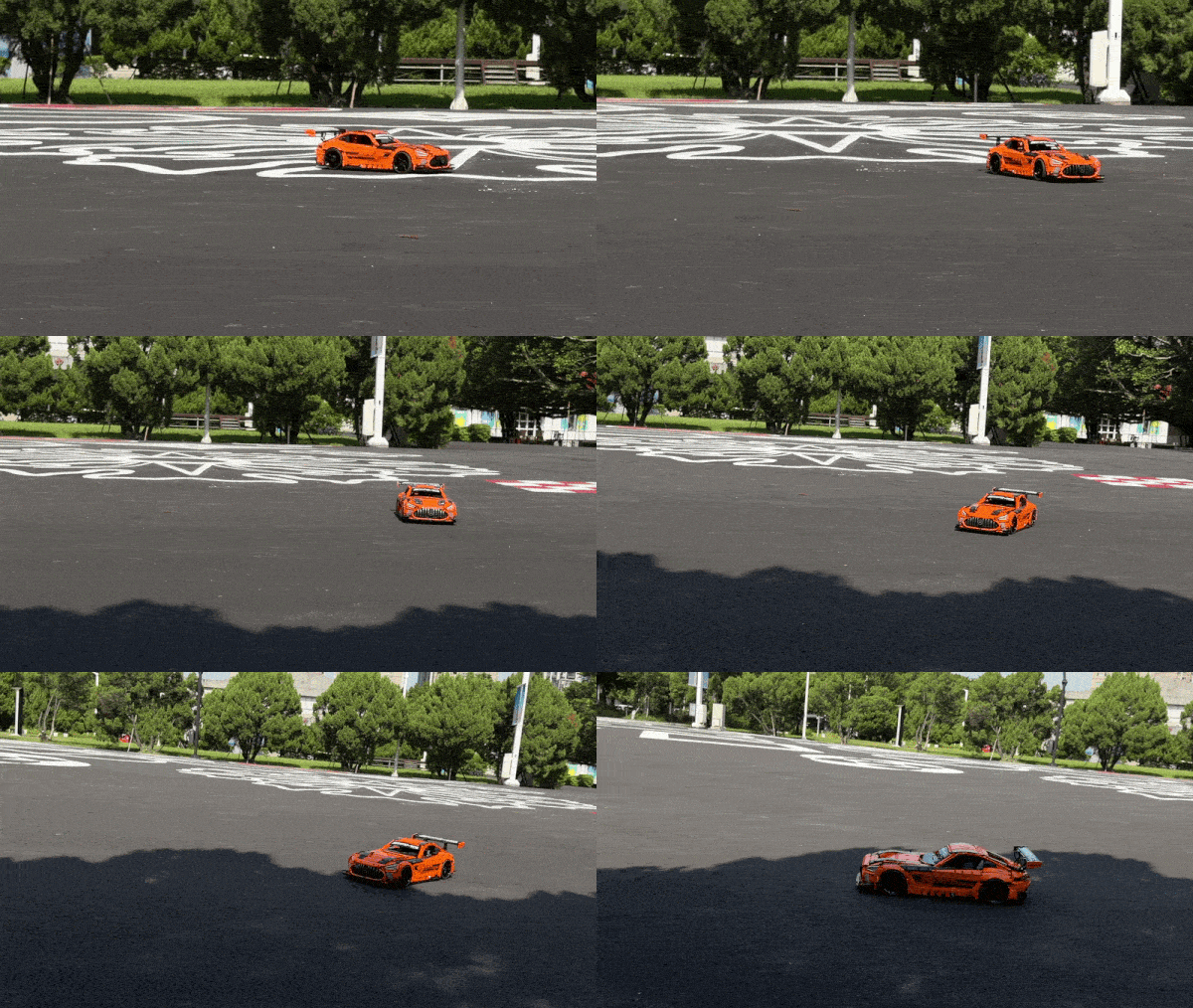
The most direct route is the Power Functions RC Kit for the CaDA AMG GT3 (High Performance) from ZENE Bricks. At its core is a brushless motor paired with a 16:1 metal planetary reduction gearbox, which converts the motor's high RPM into usable wheel torque so the car accelerates cleanly instead of spinning its wheels. A dedicated ESC manages motor speed and braking response, and the included LiPo battery fits into the chassis without changing the car's racing profile. Control comes from a 2.4 GHz remote with independent throttle and steering channels, so acceleration and steering can be operated separately and precisely, with small controller movements producing measured adjustments.
The RC kit is rated for a top speed above 20 km/h, with roughly 600 meters of anti-interference range and an average control latency around 100 ms. Runtime on a full charge is about 15 minutes, or about 10 minutes if you hold the car at full high-speed operation. Because the conversion is designed around the GT3's chassis, the brick-built body and racing shape are preserved - the car still looks like the GT3, but it now drives like a purpose-built RC model rather than a motorized display piece. The PF kit is documented with instructions and is designed to be accessible to AFOLs completing their first conversion, so novices can follow the modification without prior RC experience.
| RC Kit Specification | Detail |
|---|---|
| Motor | Brushless |
| Gearbox | 16:1 metal planetary reduction |
| Control | ESC with 2.4 GHz remote, independent throttle and steering |
| Top speed | Over 20 km/h |
| Range | Approximately 600 m (anti-interference) |
| Latency | Approximately 100 ms average |
| Battery | LiPo (included) |
| Runtime | About 15 minutes, or 10 minutes at full speed |
| Power Upgrade Kit Includes |
|

Once the conversion is complete, the difference is immediate. The metal planetary gearbox delivers torque smoothly on launch, the ESC provides proportional speed and braking control, and the 2.4 GHz link keeps the car responsive well beyond indoor range. Because the PF RC kit is built around the GT3's existing chassis, the conversion preserves the model's balance and racing profile rather than adding bulk, and the result is a car that accelerates, corners, and stops with the precision of a dedicated RC chassis while keeping CaDA AMG GT3's brick-built identity.
DIY Brushless Builds and Upgrades
For builders who prefer to engineer the conversion themselves, the community has documented several proven routes. One popular approach uses brushless wheel-hub motors from Add Power. A simpler upgrade addresses the pneumatic jack: adding a pneumatic pressure tank lets the car lift in one smooth, controlled motion instead of several pumps, which is a direct refinement of the stock hand-pump system. There is also a complete remote-control modification guide from 3rd party that takes the car past 17 km/h with a brushless setup, and that guide is designed to work alongside the ZENE Bricks kit if you already own one.
What makes the GT3 such a good platform for all of this is that it was designed to be opened. The modular roof, removable bodywork, and clean chassis layout provide easy access for installing motors, batteries, and receivers, and the hub-centered axles keep the wheels stable under real load.
Build Experience and Finish Quality
The build itself is one of the set's strengths. With 5,466 pieces, the GT3 is a substantial project, and the assembly is structured to stay interesting from the chassis up.
CaDA has invested in mold precision, and the result is a tight, consistent fit that holds the large body panels securely and keeps the many moving functions working smoothly after repeated use. For first-time large-scale builders, the payoff is a model that works as well as it looks, and the detailed printed parts make the visual portion of the build straightforward to follow.
Why the GT3 Stands Out in the Master Series
Within CaDA's lineup, the AMG GT3 occupies a distinct position as the racing flagship. It pairs the Master Series' scale and part count with a motorsport livery, aero detailing, and a competition theme, and it carries one of the most complete mechanical packages in the range: an eight-speed gearbox, linked steering and engine, adjustable independent suspension, a pneumatic jack, integrated lighting, and a motorized chassis. The printed bodywork makes the finish as durable as it is detailed, and the depth of the aftermarket ZENE Bricks RC ecosystem gives the AMG GT3 set a clear path from display model to working track car.
Final Thoughts
The CaDA Master Series Mercedes-AMG GT3 (C64008W) is a complete package: accurate, fully printed racing bodywork; a deep list of working mechanical functions; and a chassis that is ready to drive out of the box and ready to upgrade far beyond that. For builders who want a large, licensed 1:8 model that rewards both display and modification, it is one of the strongest choices available today - and if your goal is a high-speed build, the Power Functions RC Kit for the CaDA AMG GT3 is the most direct way to get there.


